Introduction: The World of Microscopic Precision
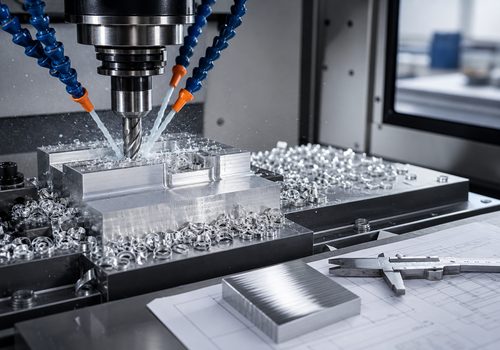
In the precision manufacturing landscape, micro CNC machining stands at the frontier of miniaturization. This advanced process involves creating intricate parts and features with tolerances measured in microns (µm) and dimensions often smaller than a human hair. It is the enabling technology behind critical innovations in medical devices (stents, surgical tools), aerospace (fuel injectors, micro-cooling channels), electronics (connectors, micro-optics), and communications.
However, machining at this scale is not merely a matter of using a smaller tool. It introduces a unique set of physical and technical challenges where the conventional rules of macro-machining break down. Successfully navigating this realm requires specialized knowledge, equipment, and strategies.
This guide explores the fundamental challenges of micro CNC machining and provides actionable solutions to achieve consistent precision, quality, and reliability.
Core Challenges in Micro Machining
1. Tool Deflection and Breakage
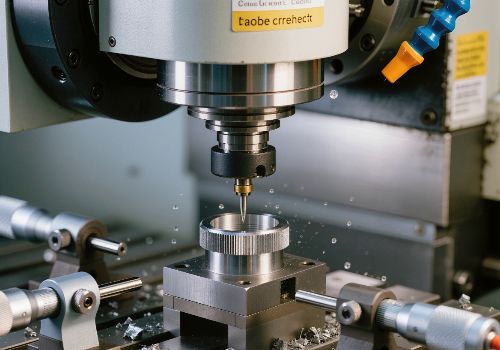
The Problem: Micro-tools, especially end mills with diameters ranging from 10 µm to 0.5 mm, have an extremely low stiffness. Even minimal cutting forces can cause them to bend or deflect. This deflection leads directly to dimensional inaccuracies, poor surface finish, and tool breakage. A tool 0.1 mm in diameter is as fragile as a human hair and can snap with the slightest lateral pressure or vibration.
The Physics: The stiffness of a tool is proportional to the fourth power of its diameter. Halving the tool diameter reduces its stiffness by a factor of 16. Consequently, a 0.2 mm tool is not twice as strong as a 0.1 mm tool—it is fundamentally, exponentially more robust.
2. Chip Formation and Evacuation
The Problem: At the micro-scale, the depth of cut is often smaller than the material’s grain size or cutting edge radius. This leads to a phenomenon called the “minimum chip thickness” effect. Instead of cleanly shearing to form a chip, the tool plows or rubs against the material, generating excessive heat, poor surface finish, and rapid tool wear. Furthermore, the tiny chips produced (micro-swarf) have a high surface-area-to-volume ratio, making them prone to adhere to the tool or workpiece, causing re-cutting and contamination.
3. Vibration and Chatter
The Problem: High spindle speeds (often 30,000 to 150,000+ RPM) are required to achieve proper cutting speeds with tiny tools. At these frequencies, even microscopic imbalances or runout can induce severe vibration (chatter). Chatter is catastrophic at the micro-scale, immediately ruining surface finish, destroying tools, and damaging the machine spindle. The natural frequencies of small, slender tools also make them highly susceptible to resonant vibration.
4. Thermal Management
The Problem: The heat generated by cutting—or even just from plowing and rubbing—is concentrated in a vanishingly small zone. Because the tools and features are so small, this heat cannot dissipate quickly. Localized thermal expansion of the tool, workpiece, or machine components can lead to significant dimensional errors relative to the part’s size. Coolant application is also challenging, as the high-pressure jet can deflect a micro-tool.
5. Process Monitoring and Metrology
The Problem: It is exceedingly difficult to observe the cutting process in real-time. Visual inspection requires high-powered microscopes, and traditional touch-probe inspection is often impossible due to feature size. Measuring the final part requires specialized non-contact metrology such as white-light interferometers or high-resolution optical coordinate measuring machines (CMMs), which are expensive and require controlled environments.
Strategic Solutions for Success
1. The Machine Tool: Foundation of Stability
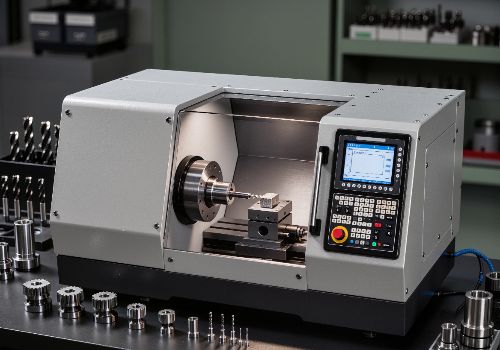
A standard CNC mill is inadequate for micro-machining. Success demands a dedicated micro-machining center designed with the following characteristics:
-
Ultra-High Spindle Speeds: Capable of 40,000 to 160,000 RPM to maintain optimal surface speed with micro-tools.
-
Extreme Rigidity and Damping: A massively stiff machine base and components to absorb and dampen vibrations before they reach the tool.
-
Sub-Micron Motion Control: Linear motors and feedback systems (like laser interferometers) that provide flawless motion resolution, accuracy, and repeatability.
-
Thermal Stability: Built with low-expansion materials and often featuring integrated cooling systems to maintain a constant temperature.
-
Low-Runout, High-Precision Spindles: Air-bearing or hybrid ceramic bearing spindles with tool holder runout measured in tenths of a micron.
2. Tooling: The Cutting Edge of Technology
Micro-tools are a specialized science. Key considerations include:
-
Material: Ultra-fine grain carbide is the standard for its hardness and toughness. For the most demanding applications in abrasive materials, micro-grain PCD (Polycrystalline Diamond) tools offer unparalleled wear resistance.
-
Geometry: Tools must be designed with polished flutes for chip evacuation and optimized helix angles. Reduced shank diameters (necked relief) behind the cutting edge can help prevent rubbing on deep walls.
-
Tool Holding: Precision collet systems like hydraulic chucks or shrink-fit holders with balance grades of G1.0 or better are mandatory to minimize runout. Any runout greater than a few microns will cause uneven tool loading and immediate failure.
3. Cutting Strategies and CAM Programming
Conventional CAM toolpaths will fail. Software and strategy must be adapted:
-
Trochoidal Milling: This is the gold standard. The tool moves in a smooth, constant-engagement circular path, drastically reducing radial forces and preventing tool deflection and breakage.
-
Peck Drilling/Cycling: For drilling and deep cavities, a pecking motion is essential to break chips and allow for cooling and lubrication.
-
Optimal Load Management: CAM software for micro-machining must allow precise control of radial engagement (step-over), which should typically be 5-15% of the tool diameter. Axial depth of cut must also be carefully managed.
-
High-Speed Machining (HSM) Techniques: Smooth, flowing motion with no sharp directional changes is critical to maintain constant load and avoid shock loading the tool.
4. Workholding and Setup
The workpiece must be as stable as the machine.
-
Specialized Micro-Vises and Fixtures: Often custom-made from stable materials like tool steel or ceramics, providing uniform, high clamping force without distorting the part.
-
Adhesive Mounting: For ultra-thin or fragile parts, wax or specific low-stress adhesives are used to mount the workpiece directly to a substrate, eliminating clamping forces.
-
Cleanliness: The work area must be meticulously clean. A single dust particle can be larger than the machining tolerance and cause a catastrophic deflection.
5. Cooling and Lubrication
Effective heat and chip removal is achieved through:
-
Mist/Cold Air Gun Systems: Deliver a precise stream of cooled, lubricated air. This removes heat and chips without the force of flood coolant.
-
Through-Tool Micro-Lubrication (MQL): A minimal quantity of high-performance lubricant is delivered directly through the tool’s center to the cutting edge. This provides lubrication exactly where needed with minimal cleanup.
-
High-Pressure Flood Coolant (with caution): Used on robust micro-setups, it must be precisely filtered and directed to avoid deflecting the tool.
Material Considerations
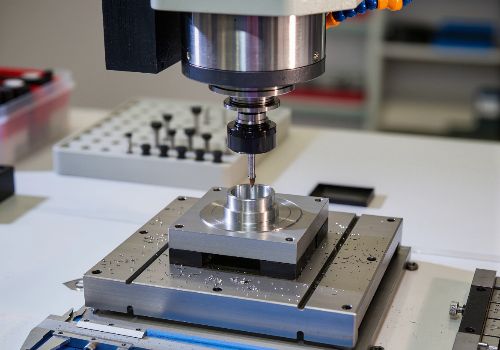
Not all materials are created equal for micro-machining. Homogeneous, fine-grained materials are preferred:
-
Good: 6061-T6 Aluminum, Brass, Fine-grained Stainless Steels (e.g., 416), Certain Plastics (Delrin, PEEK).
-
Challenging: Composites, Abrasive materials (like silicon), Soft/gummy materials (like copper) that promote built-up edge.
Table: Comparison of Macro vs. Micro CNC Machining Challenges
| Aspect | Macro/Machining | Micro-Machining |
|---|---|---|
| Primary Challenge | Material Removal Rate, Power | Tool Deflection, Vibration, Precision |
| Forces | High, managed by machine rigidity | Extremely low, but catastrophic relative to tool strength |
| Chip Evacuation | Managing volume | Preventing adhesion and re-cutting |
| Thermal Issues | Bulk heating of workpiece | Localized thermal expansion causing dimensional error |
| Metrology | Calipers, Micrometers, CMMs | Optical Microscopes, White-Light Interferometers, SEM |
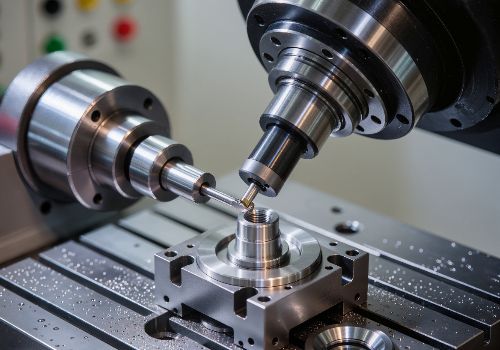
Conclusion: Mastering the Micro-Domain
Micro CNC machining is a discipline that demands respect for scale, physics, and precision. It moves from the realm of “machining” to one of “process engineering,” where every variable must be controlled. The challenges of tool fragility, vibration, and heat are significant, but not insurmountable.
The path to success is built on a foundation of purpose-built equipment, specialized tooling, intelligent CAM programming, and meticulous process control. For companies that master it, micro-machining opens the door to innovation in the world’s most advanced technological fields, manufacturing the tiny components that drive massive progress.
Ready to produce your CNC Machining parts? Contact us, please share the drawing and detail requirements, we are willing to quote for your reference.