Quick Answer
A dovetail feature is expensive to machine because it normally requires a specialty angled cutter, an open slot or pocket before the undercut can be produced, conservative cutting parameters, careful tool-access checks, and additional inspection of the angle, width, and fit.
Cost rises further when the dovetail is:
- Deep
- Narrow
- Enclosed
- Tightly toleranced
- Difficult to inspect
- Specified with a non-standard angle
- Located inside a restricted pocket
Long-reach cutters and small neck diameters can reduce tool stiffness, increasing cycle time and the risk of chatter or tool breakage.
A dovetail is easiest to quote and manufacture when the angle matches an available cutter, the entry slot is wide enough for tool access, internal radii are realistic, tolerances are applied only to functional surfaces, and the drawing clearly defines how the feature will be measured.
What Is a Dovetail Feature?
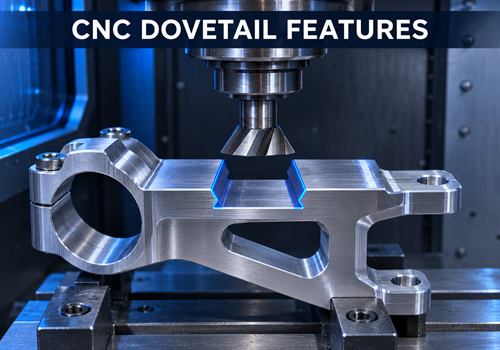
A dovetail is an angled slot, rail, guide, or undercut with sides that flare wider below the opening.
Common uses include:
- Sliding guides
- Adjustable mounting rails
- Locating features
- Mechanical retention
- Tool holders
- Clamping systems
- Replaceable wear strips
- Accessory mounting interfaces
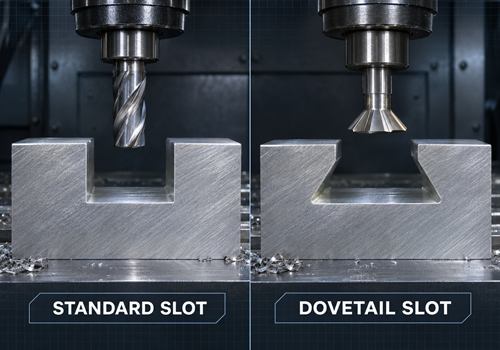
Unlike a standard open slot, a dovetail usually cannot be completed with a conventional end mill alone.
The wider area below the opening requires an angled dovetail cutter or another undercutting process.
Why a Dovetail Needs a Specialty Cutter
A standard end mill has straight sides. It can create the initial slot, pocket, or clearance area, but it cannot cut behind the narrow opening of a dovetail.
A dovetail cutter typically has:
- An angled cutting profile
- A cutter head wider than its neck
- A defined included angle
- Limited axial cutting length
- A smaller neck for undercut access
- A specific tip or corner radius
Tool manufacturers offer different combinations of included angle, cutter diameter, neck diameter, neck length, corner radius, and cutting length.
Harvey Tool’s catalog, for example, lists separate dovetail cutters for angles such as 40°, 60°, and 90°, with different neck and reach dimensions. This illustrates why the CAD feature must match an available tool or justify custom tooling. Harvey Tool dovetail-cutter example
The Main Factors That Increase Dovetail Machining Cost
1. The Feature Usually Needs More Than One Operation
A typical CNC dovetail process may include:
- Face or locate the reference surface.
- Rough the open slot with a standard end mill.
- Remove material near the angled walls.
- Finish the undercut with a dovetail cutter.
- Deburr the entry and exit edges.
- Inspect the width, angle, depth, and fit.
The dovetail cutter should not be expected to remove all the material from solid stock.
Roughing with a stronger standard tool reduces the cutting load on the more delicate specialty cutter, but it adds tool changes and machining time.
2. The Cutter Neck Is Often Less Rigid
To reach behind the slot opening, the cutter head must be larger than the neck.
This geometry reduces the cross-sectional area supporting the cutting head.
A long or narrow neck can be sensitive to:
- Deflection
- Chatter
- Vibration
- Uneven cutting load
- Premature tool wear
- Tool breakage
The machinist may need shallower radial engagement, lighter passes, lower feed, or additional finishing passes.
These choices improve process stability but increase cycle time.
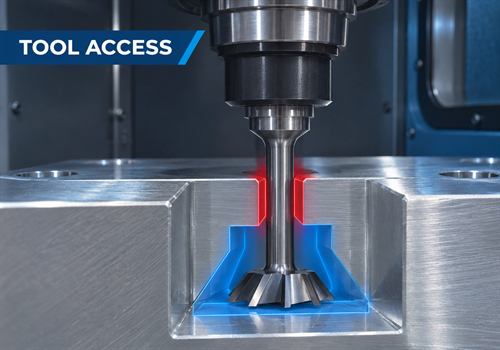
3. Tool Access May Be Restricted
The tool holder, shank, neck, and cutter head must all enter and exit the feature without colliding with the part.
Tool access becomes difficult when:
- The entry slot is too narrow.
- The dovetail is located inside a deep pocket.
- A nearby wall blocks the tool holder.
- The undercut extends around a corner.
- The feature stops before an accessible exit.
- The required neck length is unusually long.
If the tool cannot approach the feature safely, the supplier may need:
- A longer-reach cutter
- Another setup
- 4-axis or 5-axis positioning
- A custom tool
- A design change
4. Non-Standard Angles Can Require Special Tooling
Common catalog angles are easier to quote than an unusual custom angle.
If the design specifies an angle that does not match an available cutter, the supplier may need to:
- Purchase a specialty cutter
- Grind a custom form tool
- Use multiple angled operations
- Machine the feature with multi-axis interpolation
- Produce the feature by another process
The tooling cost is easier to justify for repeat production than for a one-off prototype.
5. Deep Dovetails Need Long-Reach Tools
A deeper feature may require a longer neck or greater cutter projection from the holder.
Longer reach generally reduces stiffness and increases sensitivity to tool runout.
The machinist may need to reduce cutting forces and verify the toolpath carefully.
Dovetail depth should therefore be driven by function rather than appearance.
6. Tight Width and Angle Tolerances Add Finishing Work
A dovetail may control:
- Sliding fit
- Mechanical retention
- Location
- Alignment
- Preload
- Clamping force
If the width or angle is tightly toleranced, the supplier may need:
- A dedicated finishing pass
- Tool-wear compensation
- In-process measurement
- A custom gauge
- A mating sample
- First-article inspection
- Trial assembly
Tool wear can change the finished width and contact pattern even when the machine position is correct.
7. Small Internal Radii Limit Tool Choice
A sharp or very small root radius may not match a standard dovetail cutter.
Reducing the radius can require:
- A smaller cutter
- A weaker cutting edge
- Slower feeds
- More finishing passes
- Additional deburring
If the mating component allows a larger radius or relief, the change can reduce risk and cost.
8. Closed-End Features Are Harder Than Open-Ended Features
An open-ended dovetail gives the cutter a clear entry and exit path.
A closed-end dovetail may require the cutter to:
- Enter through a prepared opening
- Stop inside the feature
- Retract safely
- Leave acceptable end geometry
- Avoid rubbing during retraction
Where function allows, opening one end of the dovetail can simplify machining substantially.
Material Affects Dovetail Cost
Aluminum
Aluminum is generally easier to machine, but a long-neck dovetail cutter can still chatter or load with chips.
Sharp tooling and effective chip evacuation are important.
Stainless Steel
Stainless steel can increase heat, cutting force, and tool wear.
Conservative engagement and appropriate tooling may be required, especially in a deep undercut.
Carbon Steel
Carbon-steel machining depends on grade and hardness.
The actual material condition should be included in the RFQ.
Engineering Plastics
Plastics may be easier to cut but can deform, melt, or create burrs.
Thin dovetail lips can also distort during machining or assembly.
How Tool Angle Affects the Finished Feature
The drawing should distinguish between:
- Included cutter angle
- Angle of each dovetail side
- Nominal width at the opening
- Width at a defined depth
- Root width
- Functional contact surface
Ambiguous angle definitions can produce quoting errors or parts that do not fit the mating component.
If the dovetail mates with an existing rail, clamp, or sample, provide the mating geometry or physical sample along with the drawing.
Why Dovetail Inspection Can Be Difficult
A standard caliper may not reach the functional width below the opening.
The angle may also be difficult to verify directly.
Inspection options can include:
- Gauge pins or balls
- Dovetail slide gauges
- Optical measurement
- Coordinate measuring machine inspection
- Custom go/no-go gauges
- Mating-part fit checks
- Measurement over wires, pins, or rollers
The drawing should define the dimension that controls fit and how it is referenced.
Applying several overlapping tight dimensions can make the feature over-constrained and difficult to inspect consistently.
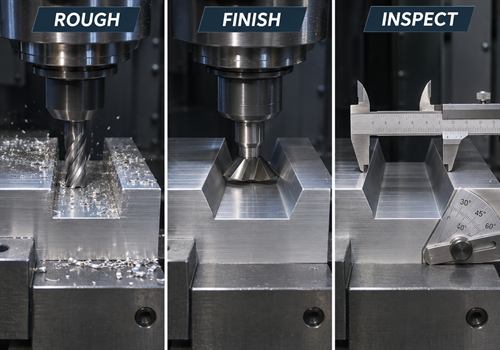
A Typical Dovetail Machining Sequence
The manufacturing sequence often follows three stages.
Rough the Access Slot
A standard end mill removes most of the material and creates room for the dovetail cutter head.
Finish the Angled Undercut
The dovetail cutter forms the angled sides and final undercut width.
Multiple radial passes may be needed to control cutting force and surface finish.
Inspect the Functional Geometry
The supplier checks the critical width, depth, angle, and contact surfaces using the agreed inspection method.
Every additional tool, pass, inspection step, and setup contributes to the quoted cost.
When Does a Dovetail Justify Custom Tooling?
Custom tooling may be reasonable when:
- The angle is functionally fixed and unavailable as a standard cutter.
- The part will be produced repeatedly.
- A dedicated tool can reduce cycle time.
- The feature must match an existing proprietary rail.
- Several dovetails share the same geometry.
- Standard tools do not provide enough reach or stiffness.
For a small prototype order, redesigning the feature around a standard cutter may be more economical.
The quote should compare the custom-tool cost with:
- Expected quantity
- Repeat orders
- Tool life
- Cycle-time reduction
- Inspection requirements
How to Make a Dovetail Less Expensive to Machine
Use a Standard Included Angle
Ask the supplier which dovetail angles and cutter sizes are readily available.
Matching a catalog tool can avoid custom-tool lead time and cost.
Provide Enough Entry Clearance
The opening must allow the cutter head, neck, and holder to reach the undercut safely.
A slightly wider access slot can sometimes prevent the need for a long-reach tool.
Keep the Dovetail as Shallow as Function Allows
Unnecessary depth increases tool reach, cutting force, and cycle time.
Open One End When Possible
An open-ended feature simplifies:
- Tool entry
- Tool exit
- Chip evacuation
- Deburring
- Inspection
Use Realistic Root Radii
Allowing a cutter-compatible radius improves tool strength and reduces finishing work.
Tolerance Only the Functional Surfaces
If the angle controls retention but the end wall does not, avoid applying the same tight tolerance to every surface.
Provide the Mating Component
A mating drawing, CAD model, or sample can help the supplier understand which dimension controls assembly.
What Should Be Included in a Dovetail RFQ?
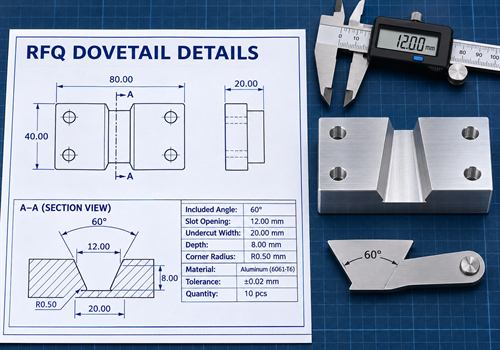
For an accurate CNC machining quote, include:
- 3D CAD model
- 2D section view
- Included angle
- Slot opening width
- Width at a defined depth
- Undercut depth
- Root and tip radii
- Open-end or closed-end condition
- Feature length
- Tolerance and datum references
- Mating-part information
- Material and material condition
- Surface finish or coating
- Quantity and repeat-order estimate
- Inspection or fit-check requirement
If the feature is flexible, state the required function instead of locking every dimension prematurely.
The supplier may be able to recommend:
- A standard cutter angle
- A larger radius
- A wider entry slot
- A more accessible geometry
- A simpler inspection method
Example: A Motorcycle Accessory Mounting Rail
Imagine an aluminum motorcycle accessory mount with a short dovetail rail for a removable light bracket.
The original design uses:
- A deep dovetail
- A closed end
- An unusual angle
- A very narrow opening
- Tight tolerances on every surface
The supplier may need:
- A specialty long-neck cutter
- A separate roughing operation
- Several light finishing passes
- A custom inspection gauge
- Extra simulation for tool clearance
If the design changes to a standard cutter angle, opens one end, increases the entry width, and relaxes the non-functional end tolerance, the machining route can become simpler without changing the retention function.
This is why an early design-for-machining review can reduce cost before the drawing is released for production.
FAQ
Why Can’t a Normal End Mill Machine a Dovetail?
A normal end mill has straight sides and cannot cut behind the narrower slot opening.
A dovetail or undercut cutter is normally required for the angled surfaces.
Are All Dovetail Angles Equally Easy to Machine?
No.
Angles that match readily available cutters are easier to source and quote.
Unusual angles may require a custom tool or multi-axis strategy.
Is a Deeper Dovetail Stronger?
Not automatically.
Strength depends on material, wall thickness, contact area, load direction, mating geometry, and stress concentration.
Extra depth may increase machining cost without improving the required function.
Does a Dovetail Need Multiple Machining Operations?
Usually, yes.
The access slot is commonly roughed with a standard end mill before the angled undercut is finished with a dovetail cutter.
How Should a Dovetail Be Inspected?
The method depends on the controlling dimension.
Gauge pins, optical inspection, CMM measurement, custom gauges, or a mating-part fit check may be used.
Can a Dovetail Be Produced on a 3-Axis CNC Machine?
Many accessible dovetail slots can be machined on a 3-axis machine with a suitable cutter.
Enclosed, angled, or obstructed features may require additional setups or multi-axis access.
Final Takeaway
A dovetail feature becomes expensive when it requires:
- A specialty cutter
- Long tool reach
- Restricted access
- Multiple machining operations
- Tight angle or width tolerances
- Difficult inspection
- Custom tooling
The most practical design uses an available cutter angle, provides enough access clearance, keeps the undercut as shallow as function allows, opens an end where possible, and defines only the dimensions that control assembly.
For an accurate quotation, send:
- 3D model
- 2D section view
- Included angle
- Opening width
- Undercut width
- Depth
- Radii
- Tolerance
- Mating component
- Material
- Quantity
- Finish
- Inspection requirements
Our CNC machining team can review dovetail features in aluminum, stainless steel, carbon steel, and engineering plastics and compare standard tooling, custom tooling, design changes, and multi-axis options.
Have a dovetail feature that needs a cost and manufacturability review? Send your drawing or 3D model for a practical quotation.