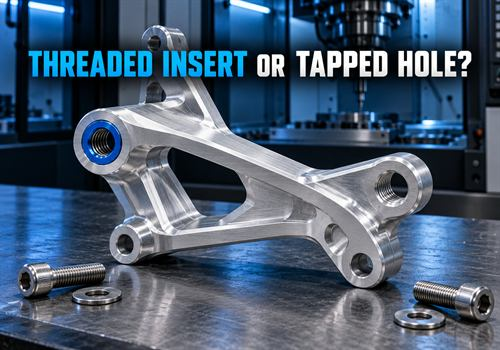
Quick Answer
A threaded insert should replace a directly tapped hole when the parent material may not provide enough durable thread engagement, when the fastener will be installed and removed repeatedly, when the part needs thread repair, or when the design requires a more wear-resistant internal thread.
Direct tapping is often the simpler and lower-cost option when:
- The material is strong enough
- The wall is sufficiently thick
- The fastener is not repeatedly removed
- The assembly load is moderate
- The thread engagement is sufficient
- The joint does not require special reinforcement
The choice depends on material, wall thickness, thread size, load, installation torque, vibration, serviceability, quantity, and the available insert type.
A threaded insert is not automatically better for every CNC part. It adds an installation operation, a larger preparation hole, and another component to control.
What Is the Difference Between a Tapped Hole and a Threaded Insert?
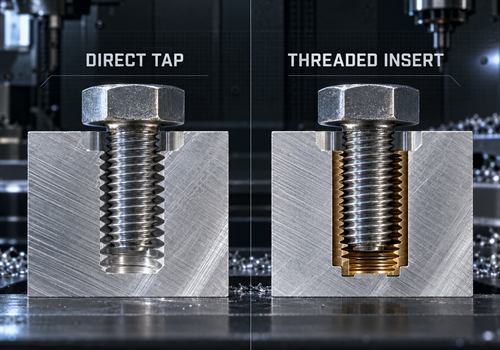
A directly tapped hole is cut into the material of the part. The internal thread is formed directly in the parent material.
A threaded insert uses a larger prepared hole and an additional threaded component installed inside the part. The screw engages the internal thread of the insert rather than the original material.
Common insert types include:
- Wire thread inserts
- Solid bushing-style inserts
- Self-tapping inserts
- Press-fit inserts
- Heat-set or molded inserts for plastics
- Key-locking or mechanically retained inserts
The correct type depends on the material, hole geometry, installation method, load, and service environment.
When Should a Threaded Insert Replace a Tapped Hole?
1. The Parent Material Is Relatively Soft
A threaded insert is often considered in aluminum, magnesium, plastics, and other materials where the internal thread may be vulnerable to stripping, wear, galling, cross-threading, or repeated damage.
This does not mean every aluminum hole needs an insert.
A direct tap can perform well when the engagement length, wall thickness, load, and installation conditions are appropriate.
An insert becomes more attractive when:
- The fastener is highly loaded
- Available thread engagement is short
- The assembly is serviced repeatedly
- The parent material is relatively soft
- The thread must resist wear over a long service life
2. The Fastener Will Be Removed and Reinstalled Many Times
Repeated assembly can wear the parent thread, especially when the part is made from a softer material or the fastener is frequently removed during maintenance.
An insert can provide a more durable internal thread and make the part easier to service over its life.
This may be relevant for:
- Motorcycle engine covers
- Battery boxes
- Skid plates
- Light brackets
- Inspection covers
- Service panels
- Adjustable mounting brackets
The insert still needs to be installed correctly. Poor installation, incorrect depth, damaged threads, or insufficient surrounding material can create a different failure mode.
3. The Available Wall Thickness Is Limited
Thin walls and small bosses may not provide enough material around a directly tapped hole.
A threaded insert can sometimes provide the required internal thread while allowing the designer to use a controlled boss or reinforced mounting area.
However, an insert usually requires a larger installation hole than a direct tap. The designer must check:
- Minimum boss diameter
- Edge distance
- Remaining wall thickness
- Insert outside diameter
- Installation depth
- Risk of splitting or distortion
An insert is not a way to ignore minimum surrounding material. The parent part must still support the installation hole and applied load.
4. The Thread Needs Improved Wear Resistance
If a fastener is tightened and loosened frequently, the internal thread may wear before the rest of the part reaches the end of its service life.
A replaceable or reinforced insert can make the threaded feature more serviceable.
The exact benefit depends on:
- Insert material
- Coating
- Thread form
- Installation quality
- Lubrication
- Fastener material
- Tightening practice
5. The Part May Need Future Thread Repair
A threaded insert can be part of the original design or used to restore a damaged thread.
For repair work, the insert allows the original fastener size to be retained after the damaged area is prepared and re-tapped.
Insert systems are commonly used to restore stripped or incorrectly tapped holes and to correct tapping errors. The repair method must match the damage and the available surrounding material.
For a new CNC part, it is better to design the insert from the beginning when serviceability is a known requirement rather than waiting for a thread failure.
6. Vibration or Joint Movement Is a Concern
Motorcycle parts may experience vibration, thermal cycling, and repeated maintenance.
A threaded insert can be useful where the joint needs a durable thread or where a specific locking thread form is required.
The insert itself does not automatically prevent bolt loosening. Joint design, clamp load, fastener selection, locking features, surface condition, and installation torque still matter.
When Is a Directly Tapped Hole Better?
A direct tapped hole may be preferable when:
- The material provides adequate thread strength
- The part has enough thread engagement
- The fastener is installed infrequently
- The load is moderate and well understood
- The wall and boss are thick enough
- The design does not require future thread repair
- The extra insert cost is not justified
- The part has many low-load threads
- Cost sensitivity is important
Direct tapping has several practical advantages:
- Fewer components
- No insert installation operation
- Simpler inspection
- Smaller preparation hole
- Lower part complexity
- Easier initial CNC programming
The supplier should still review thread depth, tap access, chip evacuation, bottom clearance, and the risk of incomplete threads in blind holes.
Threaded Insert Versus Tapped Hole: Key Design Comparison
| Design Factor | Direct Tapped Hole | Threaded Insert |
|---|---|---|
| Parent material | Works best when material has sufficient strength | Useful when material is soft, thin, or wear-sensitive |
| Repeated assembly | May wear over time | Often better suited to serviceable joints |
| Initial cost | Usually lower | Higher due to insert and installation |
| Preparation hole | Smaller | Larger and more closely controlled |
| Repairability | Damaged thread may require oversize repair | Insert can be replaced or designed for repair |
| Part complexity | Simpler | Requires insert specification and installation control |
| Inspection | Tap gauge and depth checks | Hole, insert seating, thread, and depth checks |
| Design risk | Thread stripping or wear in parent material | Insert pullout, rotation, incorrect installation, or insufficient boss strength |
The best choice is the one that meets the life-cycle requirement at an acceptable total cost.
What Should Be Specified for a Threaded Insert?
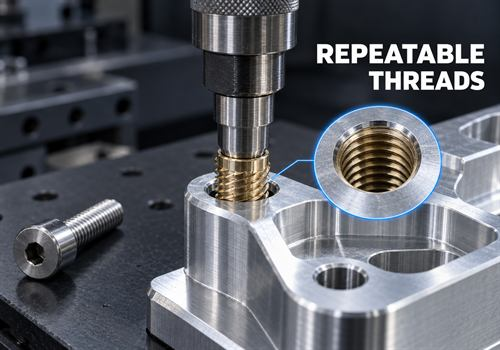
The insert should not be described only as “add an insert.”
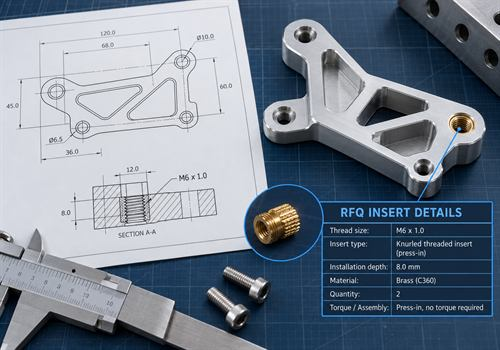
The drawing or RFQ should identify:
- Internal thread size and pitch
- Insert type or approved insert family
- Insert material, if important
- Insert length or nominal thread engagement
- Installation depth
- Locking or non-locking requirement
- Tang, key, or locking feature
- Parent material
- Prepared hole diameter and tolerance
- Minimum boss diameter or edge distance
- Surface treatment or corrosion requirement
- Final thread inspection requirement
- Installation torque or assembly instructions, if controlled
If the buyer has no fixed insert brand or type, the drawing can state the functional requirement and ask the supplier to recommend a compatible insert.
How Insert Installation Affects CNC Machining Cost
An insert adds more than the component price.
The manufacturing route may include:
- Drilling or boring the preparation hole
- Chamfering or countersinking the entry
- Tapping the special installation thread, if required
- Cleaning chips and debris
- Installing the insert
- Removing a tang or setting a locking feature
- Checking seating depth and thread quality
- Inspecting the finished assembly
The impact is easier to justify when:
- The part is a repeat order
- The insert protects a critical joint
- The alternative would be a larger redesign
- The parent material is soft
- The part requires repeated maintenance
For one-off prototypes, direct tapping may be more economical unless the prototype must represent the final service configuration.
Threaded Inserts in Aluminum CNC Parts
Aluminum parts are a common application for threaded inserts, but the design should still be reviewed carefully.
Important considerations include:
- Aluminum grade and hardness
- Thread engagement length
- Insert outside diameter
- Boss wall thickness
- Distance to nearby edges or pockets
- Installation method
- Fastener size and tightening torque
- Corrosion and galvanic compatibility
- Repeated assembly requirements
For thin motorcycle brackets, handlebar clamps, risers, engine covers, and mounting adapters, an insert may help protect the thread during service.
In other cases, a direct tap with enough engagement may be simpler and fully adequate.
Threaded Insert Use Cases
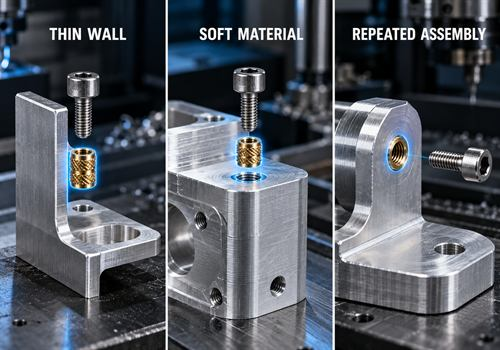
Thin Walls and Small Bosses
An insert can provide a durable internal thread in a controlled boss, provided the boss has enough surrounding material for the installation hole.
Soft Materials
An insert may reduce the risk of wear or stripping in materials that do not provide enough durable thread strength for the application.
Repeated Assembly
Service covers, adjustable brackets, and maintenance-access panels may benefit from an internal thread designed for repeated fastener removal.
Thread Repair
When a tapped hole is damaged, an insert can restore the original fastener size without replacing the entire part.
Vibration-Sensitive Joints
Some insert systems are designed with locking or anti-rotation features.
These should be selected according to the joint requirement rather than assumed to solve every vibration problem.
Thread Accuracy and Installation Quality
The final thread quality depends on:
- Preparation-hole diameter
- Installation thread
- Insert type
- Installation method
- Parent material
- Tool condition
- Inspection
For insert systems, the parent hole must be prepared to the correct diameter and geometry.
The accuracy of the installed thread depends on the accuracy of the tapped hole before the insert is installed.
Important inspection points may include:
- Preparation-hole diameter
- Installation-thread gauge result
- Insert seating depth
- Insert protrusion or recess
- Final internal thread gauge
- Free-running bolt or plug gauge
- Boss or wall condition after installation
What Should Be Included in a Threaded-Insert RFQ?
For an accurate CNC machining quote, provide:
- 3D CAD model
- 2D drawing with section views
- Parent material and grade
- Thread size and pitch
- Direct tap or insert preference, if known
- Required thread engagement
- Insert type or performance requirement
- Installation depth
- Quantity and expected repeat orders
- Surface finish and coating
- Assembly torque, if controlled
- Inspection and documentation requirements
- Application and service environment
If you are unsure whether an insert is necessary, describe the joint function instead of selecting a solution too early.
Explain:
- Fastener size
- Expected load
- Number of service cycles
- Parent material
- Available wall thickness
- Vibration or temperature conditions
- Required service life
Example: A Motorcycle Engine-Cover Fastener
Imagine an aluminum motorcycle engine cover with a small threaded hole that will be opened during regular maintenance.
A direct tap may be suitable if:
- The cover has enough material
- The screw load is low
- The service cycle is limited
- Thread engagement is sufficient
- The joint is not highly exposed to vibration
An insert may be more appropriate if:
- The fastener is removed frequently
- The aluminum wall is thin
- Thread engagement is short
- The joint is exposed to vibration or heat cycling
- Thread repair would be difficult after assembly
- The customer expects long service life
The insert adds preparation and installation work, but it may reduce the risk of damaging the cover during maintenance.
How to Reduce the Cost of an Insert-Based CNC Part
You can reduce unnecessary cost by:
- Using inserts only where the function justifies them
- Standardizing the thread size across a part family
- Avoiding unnecessary insert lengths
- Providing the required thread engagement clearly
- Confirming boss diameter and edge distance early
- Defining whether the insert is installed by the machine shop or the customer
- Limiting tight tolerances to critical features
- Sharing the expected annual quantity
- Asking the supplier to compare direct tapping, insert installation, and geometry redesign
FAQ
Is a threaded insert always stronger than a tapped hole?
No.
Performance depends on the insert type, parent material, installation quality, thread engagement, boss geometry, fastener, load, and service conditions.
Are threaded inserts necessary in aluminum?
Not always.
A direct tap may be suitable when the aluminum has enough engagement length and the joint is not heavily loaded or repeatedly serviced.
Do threaded inserts increase CNC part cost?
Usually, yes.
They add the insert component, preparation work, installation, and inspection.
They may still reduce total life-cycle cost when they prevent thread wear, repair work, or part replacement.
Can an insert repair a stripped CNC thread?
Often, yes.
The damaged hole is prepared for the repair system, and the insert restores the required internal thread size.
The repair method must match the damage and available surrounding material.
Should I specify a brand of threaded insert?
Specify a brand when the application requires an approved or qualified system.
Otherwise, specify the thread, performance, installation, and inspection requirements and ask the supplier to recommend a compatible insert.
Can threaded inserts be used in thin walls?
Sometimes.
The insert preparation hole may be larger than a direct tapped hole, so the boss diameter, edge distance, and remaining wall thickness must be checked carefully.
Final Takeaway
A threaded insert should replace a tapped hole when the parent material, service cycle, wall thickness, repair requirement, vibration environment, or thread life makes a direct tap less reliable or less serviceable.
Direct tapping remains the simpler and lower-cost option when the material is strong enough, the engagement length is sufficient, and the joint does not require repeated assembly or special reinforcement.
For a reliable CNC machining quote, provide:
- 3D model
- 2D drawing
- Parent material
- Thread size
- Wall thickness
- Required engagement
- Insert type, if known
- Quantity
- Surface finish
- Service requirements
Our CNC machining team can compare direct tapping, threaded inserts, and design alternatives for aluminum, stainless steel, and carbon-steel parts, including motorcycle brackets, engine covers, risers, clamps, adapters, and other custom components.
Not sure whether your part needs a threaded insert? Send your drawing or 3D model for a manufacturing review and quotation.