Quick answer
A machined part should be redesigned around a near-net-shape blank when the current billet removes a large amount of material, production volume is high enough to justify an upstream tooling process, and the component geometry can be formed closer to its final shape by forging, casting, extrusion, stamping, or another blank-making method.
The change is usually worth evaluating when it can reduce machining time, material waste, tool wear, part weight, or production variability. It may not be suitable for a one-off prototype, a very low-volume custom part, a simple prismatic component, or a design that changes frequently.
The decision should compare the complete manufacturing route, including blank tooling, minimum order quantity, material yield, machining allowance, heat treatment, dimensional control, inspection, and expected repeat orders.
What is a near-net-shape blank?
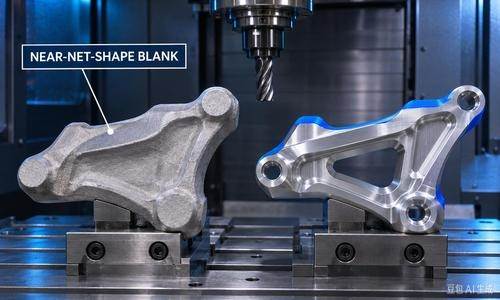
A near-net-shape blank is a starting form made closer to the final part geometry than a simple rectangular billet, round bar, or oversized plate.
Typical sources include:
– Forged blanks
– Castings
– Extrusions
– Stampings
– Powder-metal preforms
– Investment-cast shapes
– Molded engineering polymers
– Custom preforms made for a repeat product
The blank still requires CNC machining for critical surfaces, holes, threads, datums, sealing faces, and tight tolerances. Its purpose is to reduce the amount of material that must be removed during final machining.
Why redesigning the blank can reduce CNC cost
1. Less material removal
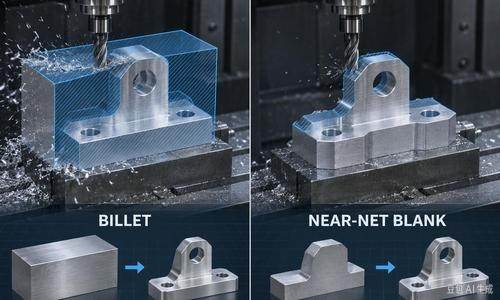
Starting from a rectangular billet can create large volumes of chips, especially for brackets, housings, structural arms, and parts with deep pockets.
A near-net blank places material closer to the finished shape. CNC machining then focuses on functional surfaces instead of removing the entire external form.
This can reduce:
– Cutting time
– Chip volume
– Tool wear
– Coolant loading
– Machine occupancy
– Material waste
2. Shorter cycle time
When less stock must be removed, the roughing stage can become shorter. The CNC process may need fewer passes and lower total spindle time.
The reduction depends on the blank geometry, stock allowance, material, cutting strategy, and the amount of finishing still required.
3. Better material utilization
A near-net blank can use material more efficiently than machining a complex part from a large block.
This may matter when:
– The raw material is expensive
– The part is large relative to its final volume
– The design contains deep pockets or thin arms
– The production quantity is high
– Material waste affects sustainability targets
4. Lower tool wear on difficult materials
Titanium, stainless steel, hardened steel, and abrasive alloys can be expensive to rough from solid stock.
Reducing the roughing volume may extend tool life and make the process easier to control. Aluminum can also benefit when the part has a large amount of unnecessary stock.
5. More consistent wall thickness and structural geometry
A formed blank can place material around ribs, bosses, and curved walls before machining.
This may support a lighter design or reduce the need to leave excessive material for structural reasons. The final design still needs to account for forming direction, shrinkage, distortion, draft, and machining datum strategy.
When is a near-net-shape blank worth considering?
Repeated production
Near-net-shape blanks usually require supplier development, tooling, process trials, and a minimum economic volume.
They are easier to justify when the same part will be produced repeatedly and the machining savings can be recovered across many units.
The review should include:
– First-order quantity
– Expected annual demand
– Repeat-order pattern
– Product life
– Blank tooling cost
– Machining-time reduction
– Material savings
– Inspection and scrap risk
Complex external geometry
Brackets, arms, housings, clamps, covers, and structural components may be good candidates when their outer form is far from a simple billet shape.
High material-removal ratio
If a large part of the original billet becomes chips, a near-net blank may improve yield and shorten roughing.
The exact break-even point depends on material price, blank cost, machine rate, order quantity, and the forming process.
Expensive or difficult-to-machine materials
A formed blank can reduce exposure to long roughing cycles in materials that create high cutting forces, heat, or tool wear.
Stable product design
Blank tooling is easier to justify when the component geometry is mature. Frequent design changes can make a dedicated blank expensive to revise or obsolete.
When should a part remain a billet-machined component?
A billet-based process may remain practical when:
– The quantity is very low
– The part is a prototype
– The design is still changing
– The geometry is simple
– The material volume is already efficient
– The blank tooling cost is not recoverable
– The forming process would add more inspection risk than value
For small custom motorcycle parts, CNC machining from plate, bar, or block may offer faster design changes and simpler purchasing.
The best route depends on the complete project rather than the shape alone.
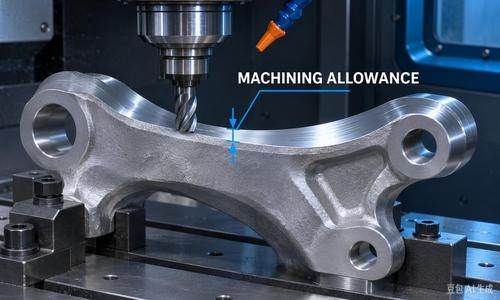
Machining allowance is a critical design variable
A near-net blank must leave enough material for final machining. The allowance must cover forming variation, distortion, surface defects, datum establishment, and the required final tolerance.
Too little allowance can create:
– Unmachined areas
– Surface defects left on the part
– Insufficient material for datums
– Inability to meet final dimensions
– High scrap risk
Too much allowance reduces the benefit of the blank and may recreate the original roughing problem.
The allowance should be reviewed separately for:
– Critical flat faces
– Curved external surfaces
– Holes and bosses
– Sealing surfaces
– Threads
– Datum features
– Areas affected by draft or distortion
How the blank-making process affects the design
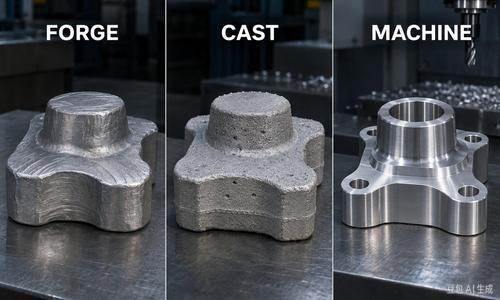
Forged blanks
Forging can create strong directional structure and place material around load-bearing areas. The design must consider parting lines, draft, forging flow, flash, distortion, and post-forging machining.
Cast blanks
Casting can form complex external geometry and internal cavities. The design review should address draft, wall thickness, shrinkage, porosity, parting lines, cores, and final machining allowance.
Extruded blanks
Extrusion can be effective for long profiles with a consistent cross-section. Cut lengths can then be CNC machined into individual parts.
Stampings and formed sheet parts
Stamping may be suitable for thin metal components with repeatable flat or formed geometry. Secondary CNC machining may finish holes, faces, and mounting features.
Powder-metal or molded preforms
These routes can reduce machining for high-volume products, but they require material, density, shrinkage, tooling, and dimensional studies.
Forging, casting, or CNC machining from billet?
The choice should consider the entire process chain.
| Factor | Billet machining | Near-net forging | Near-net casting |
|—|—|—|—|
| Prototype flexibility | High | Low to medium | Low to medium |
| Upfront tooling | Low | Higher | Higher |
| Material waste | Can be high | Often lower | Often lower |
| External geometry | Limited by machining access | Good for formed shapes | Good for complex shapes |
| Final machining | Often extensive | Still required on critical areas | Still required on critical areas |
| Design changes | Easier | More expensive after tooling | More expensive after tooling |
| Best fit | Prototypes and small batches | Stable repeat production | Complex repeat geometries |
This comparison is a starting point. The actual decision depends on part size, material, tolerances, quantity, tooling life, and supplier capability.
Datum strategy for a near-net-shape blank
A formed blank may not have the same flatness or location accuracy as a machined billet.
The CNC process should define how the first datums will be created. The supplier may need to:
1. Locate the blank using formed surfaces or temporary points.
2. Machine a primary datum face.
3. Re-fixture from the new datum.
4. Finish critical holes, profiles, and mating surfaces.
Datum design is especially important when the blank has draft, irregular outer surfaces, or forming variation.
Inspection and quality risks
A near-net blank adds another process before CNC machining. Quality control may need to cover:
– Blank dimensions
– Material condition
– Forming defects
– Distortion
– Surface defects
– Machining allowance
– Final CNC dimensions
– Heat treatment effects
– Traceability between blank and finished part
The blank should be inspected to the dimensions that affect machining. It does not need to be measured like the final component unless the forming process is itself a controlled deliverable.
Near-net blanks for aluminum motorcycle parts
Potential candidates include:
– Handlebar clamps
– Risers
– Mounting brackets
– Light brackets
– Engine covers
– Frame sliders
– Foot-peg supports
– Battery boxes
– Adventure protection parts
A forged or cast blank may reduce roughing for a complex bracket, while a CNC-machined billet may remain better for a prototype or a small design run.
The supplier should review mounting loads, cosmetic surfaces, heat treatment, anodizing, coating, and the required quantity before recommending a blank route.
What should be included in a near-net-shape RFQ?
For an accurate manufacturing review, provide:
– 3D final-part CAD model
– 2D final-part drawing
– Proposed blank process, if known
– Material and material condition
– Required heat treatment
– Final machining allowance, if specified
– Critical datums
– Tight-tolerance features
– Cosmetic or visible surfaces
– Surface finish and coating
– Quantity and expected annual demand
– Prototype or production status
– Inspection requirements
– Packaging requirements for the blank and finished part
If you are unsure whether the part should start from billet, forging, casting, or another blank, send the final model and production quantity. The supplier can compare the likely process routes and identify which surfaces should remain for CNC finishing.
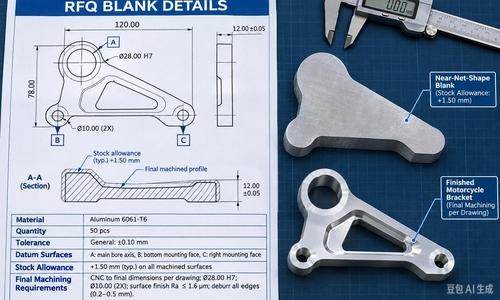
Example: redesigning a CNC motorcycle bracket
Imagine a motorcycle mounting bracket machined from a thick aluminum block.
The part contains:
– Two curved arms
– Several mounting bosses
– A deep central pocket
– A large amount of removed material
– Repeated production demand
The current billet process requires long roughing passes and generates a large volume of chips.
A forged near-net blank could place material around the arms and bosses while leaving controlled stock on the mounting faces, holes, and central pocket.
The supplier would then need to evaluate:
– Forging-tool cost
– Minimum order quantity
– Forming direction
– Draft and parting line location
– Blank distortion
– Machining allowance
– Heat treatment
– Final CNC cycle time
– Inspection and scrap risk
If the annual quantity is sufficient and the design is stable, the near-net route may reduce total cost. If the order is a small prototype batch, billet machining may remain more practical.
How to reduce the cost of a near-net-shape project
You can improve the business case by:
– Sharing expected annual demand early.
– Separating prototype requirements from production requirements.
– Identifying which surfaces must be machined and which may remain formed.
– Allowing realistic machining stock.
– Avoiding unnecessary tight tolerances on formed surfaces.
– Designing datums that can be established reliably after forming.
– Standardizing material and heat-treatment conditions.
– Asking for a billet route and a near-net route in the quotation.
FAQ
Is a near-net-shape blank always cheaper than billet machining?
No. The blank process may require dedicated tooling, minimum quantities, trials, and additional quality control. The total volume and repeat demand determine whether the savings justify the change.
Is near-net shape the same as finished shape?
No. A near-net blank is closer to the final geometry and still requires machining on critical surfaces, holes, threads, datums, and toleranced features.
Which materials work well with near-net blanks?
Aluminum, steel, stainless steel, titanium, engineering plastics, and other materials can be formed into near-net blanks. The best process depends on material grade, geometry, volume, and property requirements.
How much machining allowance should a blank have?
There is no universal value. Allowance depends on the blank process, material, size, distortion, surface condition, and final tolerance. The blank supplier and CNC machinist should review it together.
Can a prototype use a near-net blank?
Yes, but the economics may favor billet machining when the design is changing or the quantity is small. A near-net prototype can still be useful when it must represent the production process.
What is the best way to compare billet and near-net manufacturing?
Request both process routes using the same final model, material, quantity, tolerance, finish, and inspection requirements. Compare tooling, piece price, lead time, material yield, quality risk, and repeat-order economics.
Final takeaway
A machined part should be redesigned as a near-net-shape blank when the geometry removes too much material from billet, the product volume supports blank tooling, and the final design can tolerate a controlled forming process with adequate machining allowance.
The redesign should address blank geometry, datums, draft, parting lines, distortion, critical surfaces, final machining, inspection, and repeat production.
If you are developing an aluminum, stainless-steel, or carbon-steel CNC part with high material removal or repeat demand, send the final 3D model, 2D drawing, material, quantity, tolerance, finish, and application details.
Our CNC machining team can compare billet machining, forging, casting, extrusion, and other near-net-shape routes for prototypes, small batches, OEM parts, and repeat production.
Considering a near-net-shape blank for your next CNC part? Send your drawing or 3D model for a practical manufacturing review and quotation.