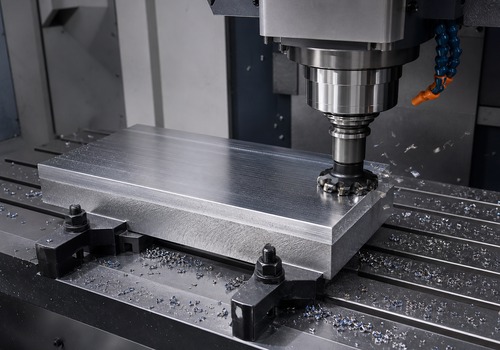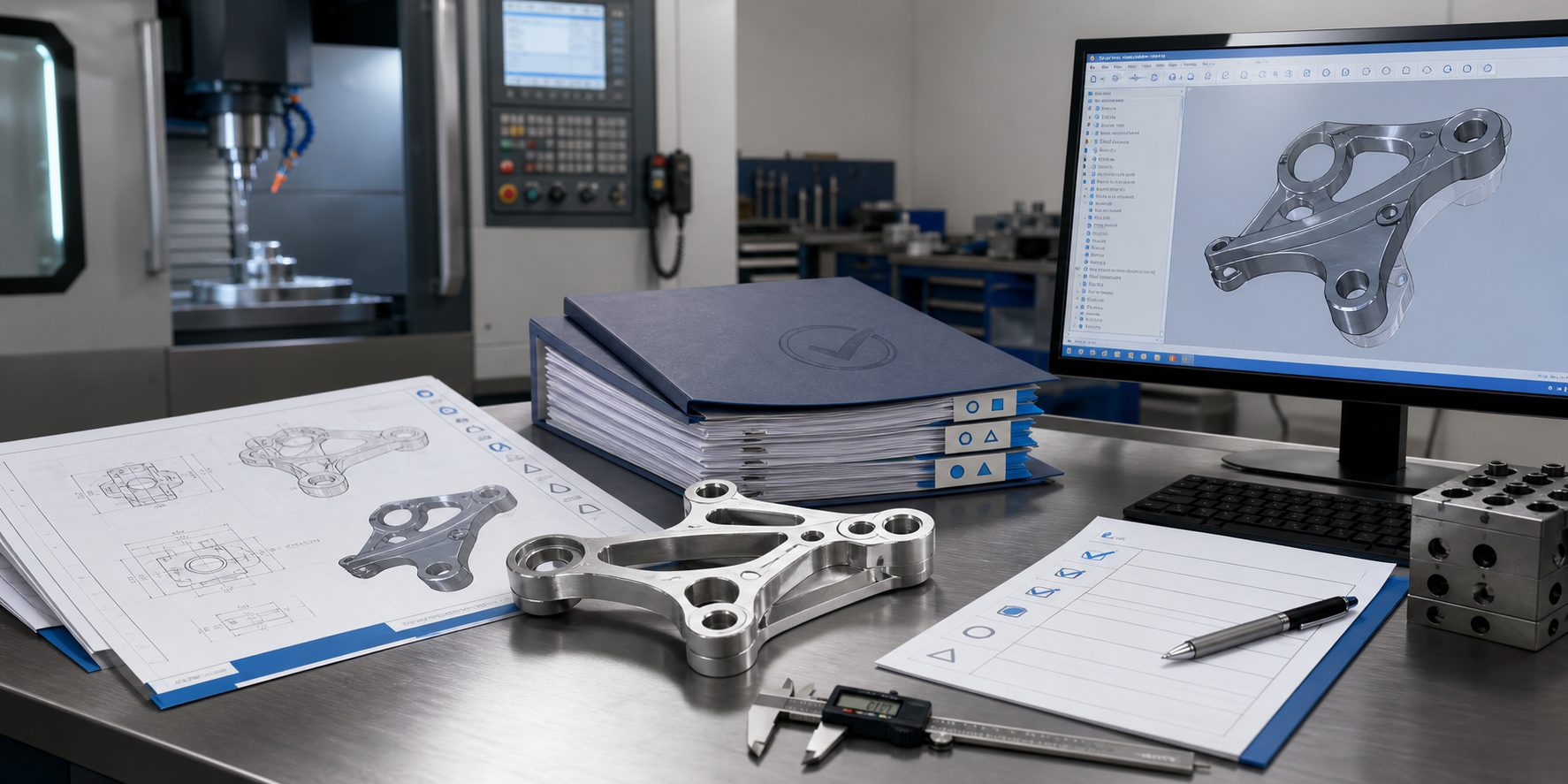
Submitting a complete CNC machining RFQ package helps manufacturers understand your requirements, evaluate manufacturability, and prepare an accurate quotation. Missing drawings, unclear tolerances, or unspecified finishes often lead to additional questions and longer quotation times.
Whether you need a single prototype or repeat production, your RFQ should clearly describe the part, material, quality requirements, and commercial expectations.
1. 3D CAD Models
Provide a 3D CAD model whenever possible. It allows the manufacturer to review the part geometry, select suitable machining methods, and estimate material usage and cycle time.
Common file formats include:
- STEP or STP
- IGES or IGS
- Parasolid X_T
- Native CAD files when agreed with the supplier
STEP is widely used because it can be opened by most modern CAD and CAM systems.
Before sending the model, confirm that it represents the latest revision. The filename should include the part number and revision level to prevent confusion.
2. Detailed 2D Engineering Drawings
A 3D model defines the geometry, but it may not communicate every manufacturing and inspection requirement. A 2D drawing should specify critical information such as:
- Overall dimensions
- Dimensional tolerances
- Geometric tolerances
- Thread specifications
- Hole depths
- Surface finish requirements
- Critical-to-function features
- Inspection points
- Drawing revision
Avoid applying unnecessarily tight tolerances to every dimension. Tight tolerances may require additional machining, specialized tooling, slower inspection, or temperature-controlled measurement.
Identify which dimensions directly affect assembly, sealing, alignment, movement, or safety. Non-critical features can often use standard machining tolerances.
3. Part Name and Application
Include a clear part name and a short description of its intended use.
For example:
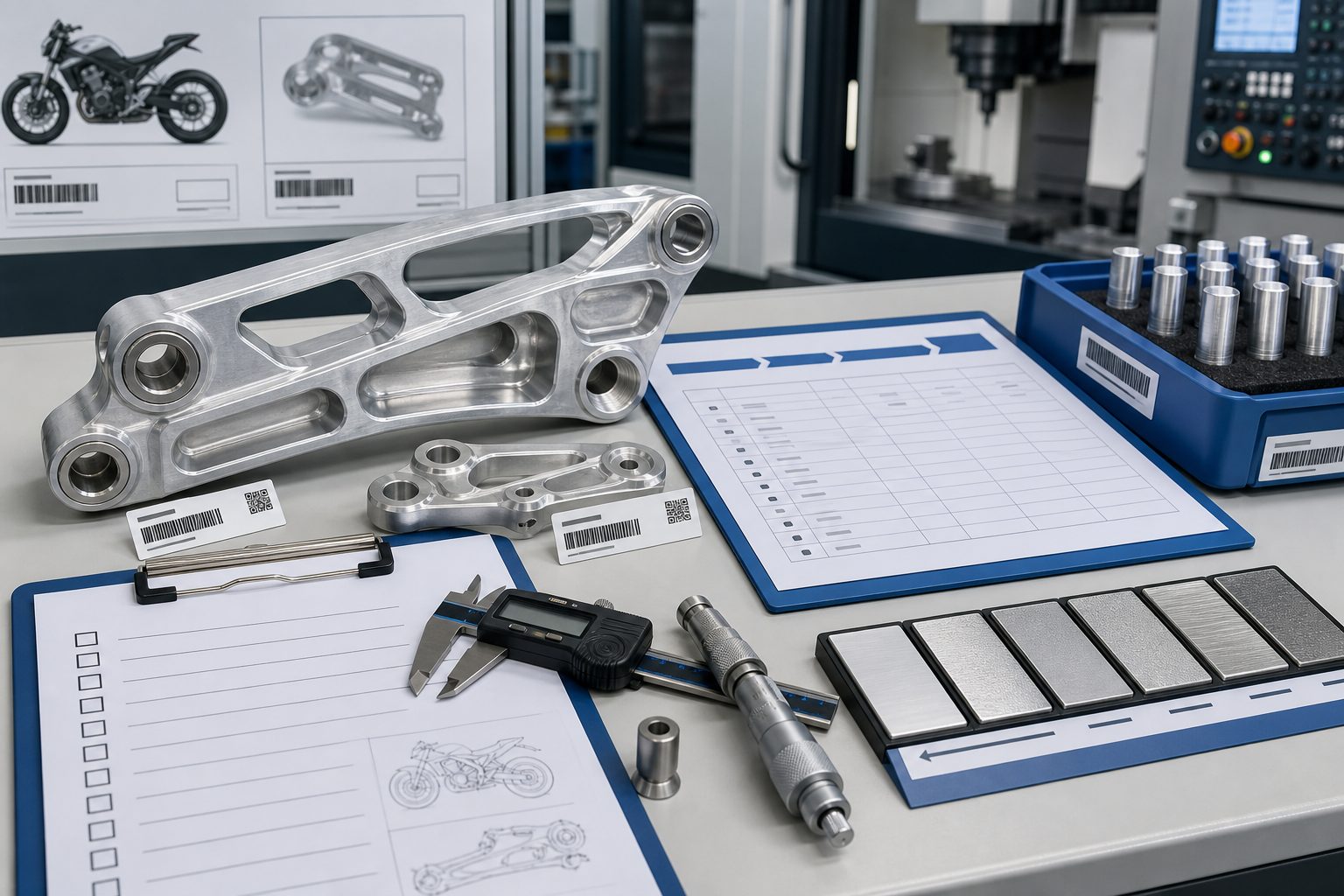
CNC-machined aluminum handlebar riser for an aftermarket motorcycle conversion kit.
Application information helps the supplier understand the functional requirements. A motorcycle mounting bracket exposed to vibration, weather, and repeated loading may require different material, finishing, and inspection considerations than a decorative cover.
Useful application details can include:
- Product or assembly name
- Motorcycle model or platform
- Indoor or outdoor use
- Expected load or vibration
- Exposure to heat, water, chemicals, or corrosion
- Relationship to mating components
Confidential information does not need to be disclosed. However, enough functional context should be provided to support a proper manufacturing review.
4. Material Specification
State the exact material grade instead of using a general description such as “aluminum” or “stainless steel.”
Examples include:
- Aluminum 6061-T6
- Aluminum 7075-T6
- Stainless steel 304
- Stainless steel 316
- Carbon steel 1018
- Alloy steel 4140
If an equivalent material is acceptable, mention this in the RFQ. The manufacturer can then suggest a locally available alternative for your approval.
Also specify whether you require:
- Material certificates
- Heat-treatment records
- Traceability documentation
- Customer-supplied material
- A particular material standard
5. Required Quantity
The quotation should state the quantity required for each part number. If you are considering several production volumes, request price breaks.
For example:
| Part Number | Prototype | Small Batch | Production |
|---|---|---|---|
| MP-101 | 2 pieces | 50 pieces | 500 pieces |
| MP-102 | 5 pieces | 100 pieces | 1,000 pieces |
Quantity affects material purchasing, fixture design, tooling, programming, machining strategy, and inspection planning. A prototype may be produced with flexible workholding, while repeat production may justify dedicated fixtures.
It is also useful to provide an estimated annual demand when available. Clearly label it as a forecast rather than a confirmed order.
6. Surface Finish and Post-Processing
Specify the required surface treatment and its appearance. Common options for machined metal parts include:
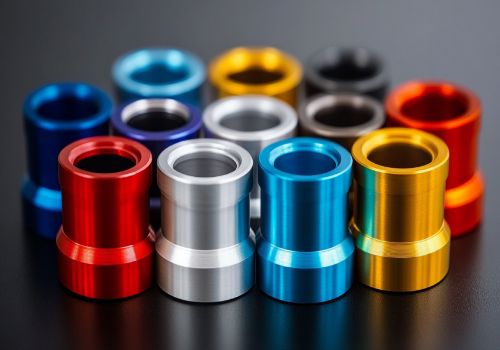
- Clear, black, or colored anodizing
- Hard anodizing
- Powder coating
- Polishing
- Brushing
- Bead blasting
- Zinc plating
- Passivation
- Heat treatment
- Laser marking
For anodized or powder-coated components, include a color reference where possible. Photographs can help communicate the intended appearance, but an agreed color standard or physical sample is more reliable.
The RFQ should also identify:
- Areas that must remain uncoated
- Threads or holes that require masking
- Cosmetic surfaces
- Acceptable tool marks
- Required coating thickness
- Surface roughness requirements
- Whether color variation is acceptable
Remember that some surface treatments can affect dimensions. Critical dimensions may need to be controlled before or after finishing, depending on the design.
7. Tolerances and GD&T Requirements
General tolerances should be stated in the drawing title block or referenced through an applicable standard. Critical features should have individual tolerances.
If geometric dimensioning and tolerancing is used, make sure the drawing clearly defines:
- Datums
- Position tolerances
- Flatness
- Parallelism
- Perpendicularity
- Concentricity or runout
- Profile requirements
The manufacturer should know which dimensions require formal inspection and which are reference dimensions.
If you are unsure whether a tolerance is practical, ask for a design-for-manufacturing review. A small tolerance adjustment may reduce machining and inspection costs without affecting part function.
8. Thread, Insert, and Assembly Details
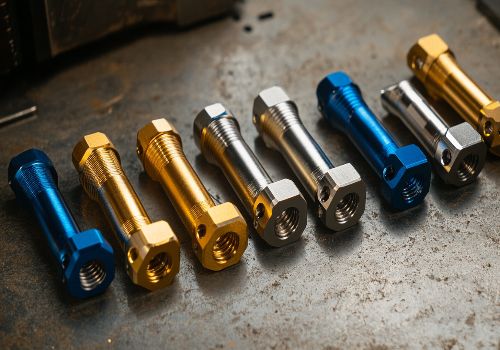
Threads should include the thread system, size, pitch, class, and depth.
For example:
- M8 × 1.25, 15 mm full thread
- 1/4-20 UNC, 0.50-inch minimum thread depth
Also identify any required:
- Helical inserts
- Press-fit pins
- Bushings
- Bearings
- Rivet nuts
- Welded components
- Customer-supplied hardware
- Adhesives or thread-locking compounds
If the manufacturer will assemble multiple components, provide an assembly drawing and bill of materials.
9. Quality and Inspection Requirements
Define the inspection documentation required with the shipment. Requirements may vary between prototypes and production orders.
Possible requirements include:
- Standard dimensional inspection
- First article inspection report
- Full dimensional report
- Material certificate
- Surface-treatment certificate
- Hardness test report
- Coating thickness report
- Sample approval before production
- Inspection photos
- Custom inspection format
State whether inspection must cover every part or use an agreed sampling plan. If special gauges or fixtures are required, clarify who will provide or approve them.
10. Packaging and Marking Requirements
Packaging is especially important for cosmetic, anodized, brushed, or polished parts. Parts can meet dimensional requirements and still become unusable if they are scratched during transportation.
Your RFQ should describe:
- Individual or bulk packaging
- Protective film or foam
- Separate compartments
- Rust-prevention requirements
- Barcode or label format
- Part number marking
- Country-of-origin marking
- Retail-ready packaging
- Maximum carton weight
If the packaging must match an existing system, provide photographs, drawings, or a sample.
11. Delivery and Shipping Information
Include the required delivery date and destination. Separate the manufacturing lead-time request from the transportation method.
Provide:
- Delivery country and postal code
- Requested quotation date
- Required sample date
- Target production delivery date
- Preferred shipping method
- Whether partial shipments are acceptable
- Requested Incoterm, if applicable
Avoid requesting an urgent delivery date without explaining which quantity is needed first. In some cases, a small prototype or partial batch can be prioritized while the remaining parts continue through production.
12. Commercial Information
A complete RFQ should also clarify the commercial scope. Consider including:
- Target order quantity
- Estimated annual volume
- Currency
- Requested price breaks
- Tooling or fixture cost requirements
- Prototype and production pricing
- Quote validity expectations
- Payment-term request
- Preferred Incoterm
- Target price, when available
A target price should be realistic and used as a reference, not as a substitute for technical information. If the quotation exceeds your target, the supplier may be able to suggest alternative materials, tolerances, finishes, or manufacturing methods.
13. Revision Control and File Organization
Organize the RFQ so that every file can be matched to the correct part.
A practical folder structure is:
RFQ_Project_Name/
├── RFQ_Summary.xlsx
├── 3D_Models/
├── 2D_Drawings/
├── Finish_References/
├── Inspection_Requirements/
└── Packaging_Requirements/
Use consistent filenames, such as:
PartNumber_Description_Revision_FileTypeFor example:
MP101_Handlebar_Riser_RevB_STEP.stp
MP101_Handlebar_Riser_RevB_Drawing.pdf
The part number and revision on the drawing, CAD model, and RFQ list should match.
CNC Machining RFQ Checklist
Before sending your request, confirm that the package includes:
- 3D CAD model
- Dimensioned 2D drawing
- Part number and revision
- Material grade
- Required quantity and price breaks
- Surface finish
- Critical tolerances
- Thread and insert details
- Inspection requirements
- Packaging instructions
- Delivery destination and requested date
- Prototype and production requirements
- Contact information for technical questions
Frequently Asked Questions
Can a CNC machining quote be prepared from a 3D model only?
A preliminary quote may be possible, but a 2D drawing is recommended when the part has critical tolerances, threads, surface-finish requirements, or inspection specifications.
Which CAD format is best for CNC machining RFQs?
STEP is generally a practical choice because it is compatible with many CAD and CAM systems. A PDF engineering drawing should be included alongside it.
Should I include a target price?
You can include a target price if it is based on realistic commercial expectations. It may help the manufacturer recommend suitable design or process changes, but complete technical information is still required.
Why should I request multiple quantity price breaks?
Pricing can change significantly with volume because programming, setup, tooling, fixtures, material purchasing, and inspection costs are distributed differently across each batch.
Conclusion
A well-prepared CNC machining RFQ package reduces uncertainty for both the buyer and the manufacturer. The most effective packages combine accurate CAD data, controlled drawings, clear material and finish specifications, realistic quantities, and defined inspection and delivery requirements.
Providing this information at the beginning helps the supplier identify manufacturing risks, ask relevant questions, and prepare a quotation that is easier to compare and approve.
Need help preparing your RFQ package? Contact our engineering team for a no-obligation review of your project specifications.