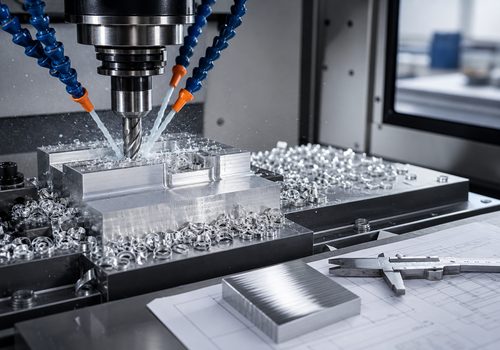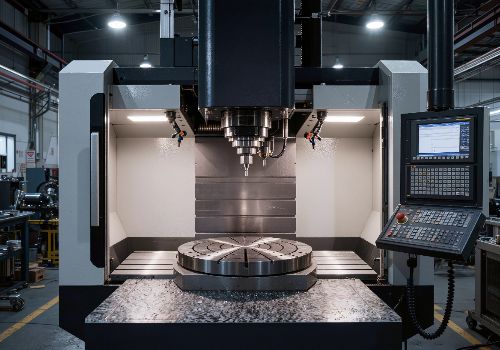
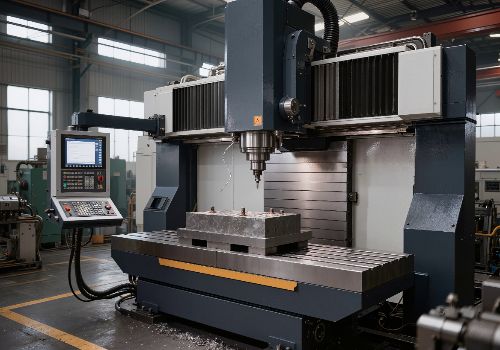
5-axis CNC machining works by moving a cutting tool or workpiece simultaneously along five different axes — the three linear axes (X, Y, Z) plus two rotational axes (typically A and B, or B and C). This simultaneous motion allows the tool to approach the workpiece from virtually any direction, enabling the machining of complex geometries, deep cavities, and intricate features in a single setup without manual repositioning.
Introduction: From Flat Planes to Spatial Freedom
For decades, conventional CNC machining relied on three axes — moving left-right (X), front-back (Y), and up-down (Z). While effective for countless applications, this 3-axis approach has inherent limitations. Complex parts like turbine blades, impellers, and medical implants require machining from multiple angles. With 3-axis machines, operators must stop the process, manually reposition the workpiece, and start again — each repositioning introducing potential errors and consuming valuable time .
Enter 5-axis machining. By adding two rotational axes to the standard three, 5-axis CNC machines achieve what engineers once only dreamed of: the ability to machine virtually any surface of a part in a single, continuous operation. This technological leap transforms how complex components are manufactured, delivering unprecedented precision, efficiency, and design freedom.
Understanding the Five Axes
The Cartesian Foundation: X, Y, and Z
To understand 5-axis machining, we start with the Cartesian coordinate system, named after the philosopher and mathematician René Descartes. In the 17th century, Descartes famously described a fly’s position in a room using just three numbers — a concept that became the foundation of modern geometry .
In CNC machining:
-
X-axis represents left-to-right movement
-
Y-axis represents front-to-back movement
-
Z-axis represents up-and-down movement
These three linear axes form the backbone of every CNC machine, from the simplest 3-axis mill to the most advanced 5-axis machining center .
The Rotational Dimensions: A, B, and C
The “fifth dimension” in 5-axis machining comes from two rotational axes added to the three linear movements. These rotational axes are typically labeled:
-
A-axis: Rotation around the X-axis (tilting the workpiece or tool forward/backward)
-
B-axis: Rotation around the Y-axis (tilting side-to-side)
-
C-axis: Rotation around the Z-axis (spinning like a turntable)
In a 5-axis machine, only two of these three rotational axes are used, depending on the machine configuration. The specific combination determines how the machine achieves its multi-directional capability .
Table: Understanding the Five Axes in CNC Machining
| Axis Type | Axis Label | Movement Description | Common Configuration |
|---|---|---|---|
| Linear | X | Left to right | Universal |
| Linear | Y | Front to back | Universal |
| Linear | Z | Up and down | Universal |
| Rotary | A | Rotation around X-axis (tilting) | Trunnion tables |
| Rotary | B | Rotation around Y-axis (tilting) | Swivel heads |
| Rotary | C | Rotation around Z-axis (spinning) | Rotary tables |
Machine Configurations: How 5-Axis Motion Is Achieved
Not all 5-axis machines are built the same way. The mechanical architecture — specifically, which components move and how — determines the machine’s strengths and ideal applications.
Trunnion-Style Machines (Table/Table Configuration)
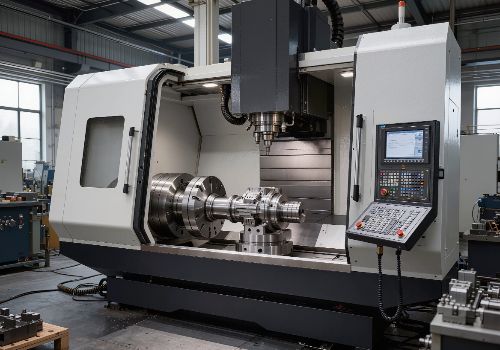
In trunnion-style machines, the table itself provides both rotational movements. The table tilts (A-axis) and rotates (C-axis) while the cutting tool moves along the X, Y, and Z axes. This design is named after the trunnion — the U-shaped support structure that enables the tilting motion.
Advantages:
-
Excellent for smaller, complex parts
-
Superior access to deep cavities and undercuts
-
Highly rigid for heavy cutting operations
Best applications: Mold making, aerospace components, and medical implants where complex geometries require aggressive material removal.
Swivel-Head Machines (Head/Head Configuration)
In swivel-head machines, the rotational axes are built into the spindle head rather than the table. The spindle can tilt (B-axis) and rotate (C-axis) while the table remains stationary.
Advantages:
-
Can handle extremely large and heavy workpieces (the table never moves)
-
Greater flexibility for parts that would be difficult to reposition
-
Extended reach for tall or oddly shaped components
Best applications: Large aerospace structures, heavy equipment components, and parts that exceed typical table weight limits.
Hybrid (Head/Table Configuration)
Some machines combine both approaches: one rotational axis in the spindle and another in the table. This hybrid configuration offers a balance between flexibility, speed, and rigidity, making it a popular choice for general-purpose 5-axis applications.
5-Axis Indexing vs. Simultaneous 5-Axis: Understanding the Difference
One of the most common points of confusion is the distinction between “5-axis indexing” (also called 3+2 machining) and “simultaneous 5-axis machining.” Both use five axes, but they operate very differently.
3+2 Machining (Positional 5-Axis)
In 3+2 machining, the two rotational axes lock into a fixed position, and then the machine performs standard 3-axis machining. The tool orientation is fixed during the cut, but the machine can reposition the workpiece between operations to access different faces.
Key characteristics:
-
Rotational axes lock during cutting
-
Tool orientation remains fixed per operation
-
Multiple setups can be performed in one clamping
-
Simpler programming than full simultaneous
Best for: Machining parts with features on multiple faces — angled holes, compound angles, and prismatic parts with complex orientations.
Simultaneous 5-Axis Machining
In true simultaneous 5-axis machining, all five axes move continuously throughout the cutting operation. The tool follows complex curves and surfaces while constantly adjusting its orientation relative to the workpiece.
Key characteristics:
-
Continuous motion across all five axes
-
Tool orientation changes during cutting
-
Superior surface finish on contoured surfaces
-
Requires advanced CAM programming
Best for: Turbine blades, impellers, medical implants, and any part with complex 3D surfaces requiring smooth, continuous tool motion.
*Table: 3+2 vs. Simultaneous 5-Axis Machining*
| Feature | 3+2 Machining (Positional) | Simultaneous 5-Axis |
|---|---|---|
| Motion type | Rotational axes lock, then 3-axis cut | All five axes move continuously |
| Tool orientation | Fixed during each operation | Changes dynamically during cut |
| Programming complexity | Moderate | Advanced |
| Surface finish | Good | Superior |
| Ideal for | Multi-face prismatic parts, angled features | Complex contours, freeform surfaces |
| Typical cycle time | Faster for simple geometries | Optimized for complex curves |
The Critical Technology: RTCP (Rotational Tool Center Point)
One of the most important technologies enabling effective 5-axis machining is RTCP — Rotational Tool Center Point. This feature, found on modern 5-axis CNC controls, automatically compensates for the movements of the rotational axes, keeping the tool tip precisely positioned at the programmed point in space .
Without RTCP, programmers would need to calculate complex tool position offsets every time the tool angle changed — an almost impossible task for complex parts. With RTCP, the control handles these calculations automatically, allowing programmers to focus on toolpath strategies rather than complex coordinate transformations.
RTCP is particularly critical for:
-
Maintaining precision when tilting the tool around corners
-
Avoiding collisions between the tool holder and workpiece
-
Simplifying programming for complex multi-surface parts
Key Benefits of 5-Axis Machining
1. Single-Setup Machining
The most significant advantage of 5-axis machining is the ability to complete complex parts in a single setup. A workpiece can be machined on five sides without manual repositioning.
Impact: Elimination of multiple fixtures reduces setup time, eliminates cumulative positioning errors, and improves part-to-part consistency. Aerospace blade production, for example, sees pass rates increase from approximately 85% with 3-axis methods to 99% with 5-axis machining.
2. Shorter, More Rigid Cutting Tools
When machining deep cavities or complex features with 3-axis machines, long tools are often required to reach into tight spaces. Long tools deflect under cutting forces, reducing precision and surface quality.
With 5-axis machining, the ability to tilt the tool or workpiece means the tool can remain short and rigid while still accessing difficult features. Shorter tools deflect less, last longer, and produce better surface finishes.
3. Improved Surface Finish
In 5-axis machining, the cutting tool can maintain an optimal angle relative to the workpiece surface throughout the cut. This constant, ideal engagement produces smoother surface finishes and often eliminates the need for secondary polishing operations.
For applications requiring smooth contours — such as fluid flow components, turbine blades, and medical implants — this surface quality advantage is critical.
4. Reduced Cycle Times
By eliminating multiple setups and enabling more efficient toolpaths, 5-axis machining can dramatically reduce total production time. Research indicates that for complex parts, 5-axis systems can reduce machining time by up to 84% compared to conventional 3-axis approaches .
Real-world example: An automotive gearbox housing that previously required 4 hours of machining time across multiple setups can be completed in 1.5 hours on a 5-axis machine.
5. Part Consolidation
5-axis machining’s ability to create complex geometries in a single part often eliminates the need for multi-piece assemblies. Rather than machining separate components and welding or bolting them together, engineers can design a single, integrated part .
Benefits: Reduced assembly time, lower inventory costs, improved part strength, and reduced weight — critical advantages in aerospace and automotive applications.
6. Enhanced Accuracy
Each time a part is repositioned in a 3-axis machine, errors can be introduced — misalignment, fixture variations, and operator differences. 5-axis machining’s single-setup capability eliminates these cumulative errors, achieving positioning accuracy within 0.005 mm.
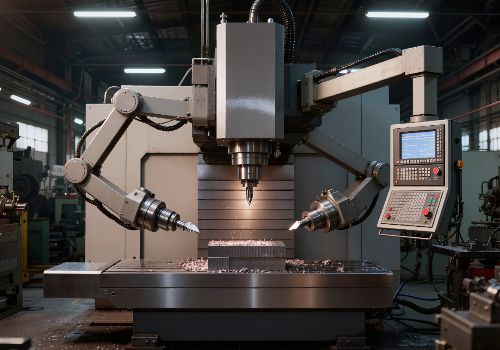
Applications and Industries
The unique capabilities of 5-axis machining make it indispensable across several demanding industries:
Aerospace
-
Components: Turbine blades, impellers, structural airframe parts, engine housings
-
Why 5-axis: Complex aerodynamic surfaces require continuous tool motion; single-setup machining ensures precision for safety-critical components
Medical Device Manufacturing
-
Components: Orthopedic implants (hips, knees), spinal hardware, surgical instruments, dental prosthetics
-
Why 5-axis: Patient-matched implants require complex, organic geometries; biocompatible materials like titanium demand precise, efficient machining
Automotive
-
Components: Engine blocks, cylinder heads, transmission cases, suspension components, prototype tooling
-
Why 5-axis: Complex internal passages and lightweight designs require multi-directional machining; rapid prototyping benefits from reduced setup time
Mold and Die Manufacturing
-
Components: Injection molds, stamping dies, casting patterns
-
Why 5-axis: Deep cavities, complex cores, and intricate details require tool access from multiple angles; superior surface finish reduces hand-polishing time
Energy and Oil & Gas
-
Components: Pump housings, valve bodies, turbine components, drilling equipment
-
Why 5-axis: Large, complex parts with demanding material requirements benefit from single-setup machining
Challenges and Considerations
Despite its advantages, 5-axis machining comes with challenges that shops must address:
Higher Initial Investment
5-axis machines cost significantly more than 3-axis equivalents. Entry-level models range from $60,000 to $120,000, while high-end production machines can exceed $1 million. Additional costs include specialized tooling, CAM software, and postprocessors.
Complex Programming
Creating toolpaths for 5-axis machines requires advanced CAM software and a deep understanding of machining principles. Tool orientation, collision avoidance, and machine kinematics add layers of complexity beyond 3-axis programming.
Collision Risk
With more axes of motion and tighter clearances, the risk of collisions between the tool, holder, workpiece, and fixture increases significantly. Simulation and verification become essential, not optional .
Skilled Operator Demand
Running 5-axis machines effectively requires highly trained operators and programmers — expertise that can be difficult to find and expensive to develop. However, as the technology becomes more common, training resources and user-friendly interfaces are improving accessibility.
The Future of 5-Axis Machining
The evolution of 5-axis technology continues rapidly, driven by several emerging trends:
AI-Powered Optimization
Artificial intelligence is increasingly integrated into CAM systems, enabling automatic toolpath optimization, tool wear prediction, and real-time error detection. Future systems may analyze part geometry and select optimal machining strategies without human intervention.
Digital Twins and Simulation
Advanced simulation software creates exact digital replicas of machines, tools, and workpieces — “digital twins” that allow programmers to verify and optimize entire machining processes virtually before cutting any material.
Hybrid Manufacturing
The integration of additive manufacturing (3D printing) with 5-axis machining in single platforms is opening new possibilities. Parts can be built up near-net shape through additive processes, then finished to precise tolerances with subtractive machining — all in one machine.
Lights-Out Automation
Combined with robotic work handling and pallet systems, 5-axis machines are increasingly capable of unattended, “lights-out” operation — running through nights and weekends with minimal human intervention.
Conclusion: A Technological Leap
The transition from 3-axis to 5-axis CNC machining is far more than an incremental improvement — it represents a fundamental shift in manufacturing capability. Where 3-axis machining offers “planar freedom,” 5-axis delivers true “spatial freedom” — the ability to approach a workpiece from any direction, machine any surface, and create geometries previously impossible or impractical to produce .
For manufacturers facing increasingly complex parts, tighter tolerances, and shorter lead times, 5-axis machining is moving from a competitive advantage to a business necessity. The initial investment is significant, but the returns — in reduced setup time, improved accuracy, better surface finishes, and expanded capability — often justify the cost within two years for the right applications .
From the turbine blades that power jet engines to the implants that restore mobility, 5-axis CNC machining is quietly shaping the world around us — one precise cut at a time.
Ready to explore how 5-axis machining can transform your complex part production? [Contact our engineering team] for a free consultation on your next precision component project.