Quick Answer
Undercuts justify custom tooling in CNC milling when the feature is functionally necessary, cannot be redesigned without compromising the part, and will be produced in enough quantity to support the additional tooling cost and setup work.
For a one-off prototype, redesigning the geometry or adding a standard relief is often more economical. For repeat production, a custom cutter may be reasonable when it improves tool access, reduces manual work, protects a critical surface, or makes the process more repeatable.
The right decision depends on geometry, material, tolerance, quantity, machine access, and the expected life of the product.
What Is an Undercut in CNC Milling?
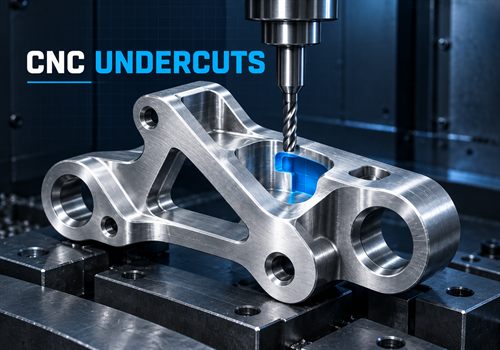
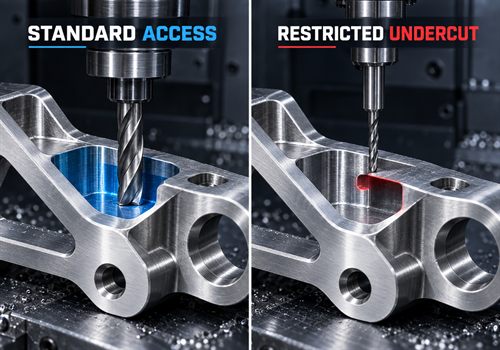
An undercut is a feature that cannot be reached by a standard cutting tool moving only from the primary top, side, or bottom direction.
Common examples include:
- A recess beneath an overhanging wall
- A T-slot or dovetail-like feature
- A groove under a flange
- A hidden shoulder inside a pocket
- A curved or hooked profile that blocks a straight cutter
The difficulty is not simply that the feature is small. The main issue is line-of-sight access. If the tool body, holder, or spindle cannot reach the material without colliding with the part, a conventional 3-axis toolpath may not be enough.
Why Undercuts Can Increase CNC Machining Cost
An undercut may affect several parts of the manufacturing process at once:
- Tool selection: A standard end mill may not have the required reach, diameter, neck relief, or cutting profile.
- Machine access: The part may need to be repositioned or machined on a 4-axis or 5-axis platform.
- Programming: The toolpath may require additional simulation and collision checking.
- Setup time: Extra fixtures or orientations can increase setup work.
- Inspection: Hidden features can be more difficult to measure and verify.
- Tool life: A narrow or extended cutter may deflect, vibrate, or wear faster.
The best quote is therefore not based on the undercut alone. It should consider the entire process route.
When Should You Consider Custom Tooling?
1. The Undercut Is Essential to the Part’s Function
Custom tooling is easier to justify when the undercut controls assembly, retention, sealing, movement, or another important function.
If removing the feature would make the part fail its application, the question should change from:
“Can we eliminate the undercut?”
to:
“What is the most reliable way to produce it?”
For example, an undercut in a motorcycle mounting bracket may provide clearance for a fastener head, cable, or mating component. In that case, a redesign that changes the clearance envelope may create an assembly problem even if it lowers machining cost.
2. The Part Will Be Produced Repeatedly
Custom tooling has a fixed engineering and preparation cost. That cost is easier to absorb when the same part will be ordered repeatedly.
A supplier can evaluate the tooling cost against:
- Expected order quantity
- Annual demand
- Repeat order frequency
- Cycle-time reduction
- Tool life
- Inspection and rework risk
For a small prototype run, the most economical solution may be a standard cutter, a different machine orientation, or a design change.
For repeat production, a dedicated form tool or special undercut cutter may provide a more stable process.
3. A Standard Cutter Would Create Too Much Deflection or Vibration
Deep, narrow undercuts often require a long-reach tool. The longer the tool extends from the holder, the more sensitive it can become to cutting force and vibration.
This can lead to:
- Poor surface finish
- Dimensional variation
- Chatter marks
- Premature tool wear
- Unstable cycle times
A custom tool with a more suitable diameter, neck profile, or cutting edge can sometimes improve access and stiffness.
However, the tool should still be evaluated with realistic cutting parameters and a tool-life expectation. A custom cutter is not automatically better in every application.
4. The Undercut Protects a Critical Surface
Sometimes a general-purpose tool can reach the feature but risks rubbing against a finished wall or damaging an adjacent surface.
A custom cutter may provide the clearance needed to isolate the cutting edge from the protected area.
This can be valuable for visible motorcycle parts such as:
- Handlebar clamps
- Risers
- CNC foot pegs
- Mounting brackets
- Engine covers
- Frame sliders
- Decorative aluminum components
For these parts, appearance and fit often matter together.
5. A Custom Tool Can Reduce Secondary Operations
If the alternative is machining the feature in several stages, adding manual work, or using a separate EDM or grinding operation, custom CNC tooling may become commercially attractive.
The supplier should compare the complete route, including:
- Additional setups
- Fixture changes
- Deburring
- Manual blending
- Inspection time
- Risk of handling marks
- Total lead time
The cheapest cutter is not always the lowest-cost manufacturing route.
When Is Redesign Better Than Custom Tooling?
Custom tooling should not be the default answer.
Redesign is often better when the undercut exists only because of a sharp internal transition, an unnecessary decorative detail, or a feature that can be replaced by a standard radius or relief groove.
Consider redesign first when:
- The part is a one-time prototype
- The feature is not functionally required
- A standard relief can achieve the same clearance
- The undercut has a very tight tolerance but no inspection access
- The order quantity is too low to spread tooling cost
- A small change would allow standard 3-axis access
- The design is still early enough for engineering changes
Typical design alternatives include:
- Opening the pocket
- Changing the wall direction
- Adding a relief groove
- Increasing an internal radius
- Splitting the part into multiple components
- Changing the assembly sequence
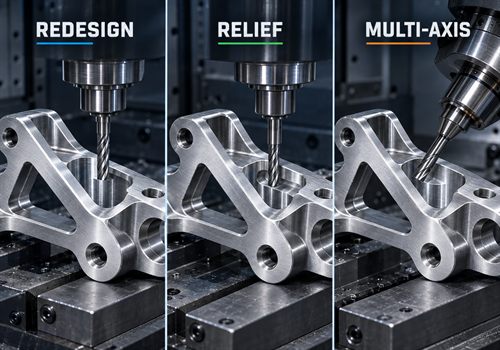
Custom Tooling Versus 4-Axis or 5-Axis Machining
Custom tooling is only one possible solution. Depending on the feature, the part may be better suited to a different machine strategy.
3-Axis Machining
3-axis machining can work when the undercut can be exposed by a practical setup or when a standard tool has enough access.
It is often attractive for:
- Simple parts
- Prototypes
- Low-volume production
- Parts with open access
- Designs that use standard radii and reliefs
4-Axis Machining
Rotary positioning can expose multiple sides of a component without creating a completely new fixture for every feature.
This may help with:
- Wraparound grooves
- Features located around a cylindrical body
- Radial mounting parts
- Circular brackets
- Motorcycle spacers and adapters
5-Axis Machining
Simultaneous or indexed 5-axis machining can improve approach angles and reduce repositioning.
It may be useful when:
- The undercut is part of a complex surface
- Several faces must remain aligned
- The feature requires an angled tool approach
- Multiple setups would create alignment risk
- Surface continuity is important
Custom Tooling
A special cutter may be suitable when:
- The feature geometry is consistent
- The required reach is known
- The tool profile can be defined clearly
- Repeat production justifies the investment
- The tool can improve process stability
A capable supplier should compare these options rather than recommend custom tooling automatically.
What Information Should Be Included in an Undercut RFQ?
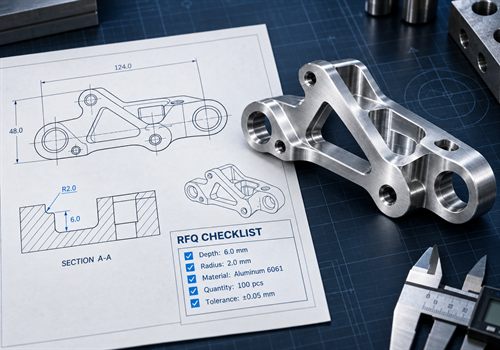
Clear RFQ information helps the manufacturer decide whether the part needs a special cutter, another machining orientation, or a design review.
Include:
- 3D CAD model in a common format
- 2D drawing with the undercut shown in a section view
- Undercut width, depth, and internal radius
- Material and material condition
- Required quantity and expected repeat-order pattern
- Dimensional tolerances and critical datums
- Surface-finish requirements
- Visible or cosmetic surfaces
- Functional purpose of the undercut
- Inspection method if the feature is hidden
- Packaging or protection requirements for finished surfaces
If you do not know the exact undercut radius or manufacturing route, state the required function and let the machining supplier recommend a practical option.
It is better to identify uncertainty early than to force an arbitrary dimension into the drawing.
How a CNC Supplier Should Evaluate the Request
A useful manufacturing review should answer five questions:
- Can the feature be produced with a standard tool?
- Can the part be repositioned to improve access?
- Would a 4-axis or 5-axis operation reduce risk?
- Would a design change remove the undercut without affecting function?
- If custom tooling is needed, can the tooling cost be justified by quantity and repeat demand?
The review should also address:
- Tool access
- Workholding
- Material behavior
- Burr control
- Inspection
- Surface finish
- Process repeatability
This gives the buyer a realistic comparison between design change, special tooling, and multi-axis machining.
Example: A Custom Motorcycle Bracket
Imagine a motorcycle light bracket with a recessed underside that clears a frame tube.
The recessed feature is functional, but a standard top-down end mill cannot reach the full profile.
There are several possible routes:
- Redesign the bracket with an open side
- Add a relief that preserves frame clearance
- Rotate the part for indexed machining
- Use a smaller extended-reach cutter
- Commission a custom form tool for repeat production
For a prototype, an indexed setup may be the most practical choice.
For a repeat order with stable geometry, a dedicated cutter may reduce cycle time and improve consistency.
The correct answer should be based on the complete quote, not on the tool price alone.
How to Reduce the Cost of an Undercut Machining Project
You can often improve manufacturability without removing the feature.
Helpful actions include:
- Provide a section view and highlight the functional area
- Specify only the tolerances that matter
- Avoid unnecessarily tight cosmetic tolerances inside hidden areas
- Confirm whether the undercut radius can use a standard tool profile
- Share expected annual quantity, not only the first order
- Identify surfaces that must remain cosmetic
- Ask for two or three process options in the quotation
This information helps the supplier propose a solution that balances cost, quality, and repeatability.
FAQ
Are all CNC undercuts made with custom tools?
No.
Some can be produced with standard cutters, a different setup, a relief feature, or a 4-axis/5-axis operation.
The geometry and access determine the method.
Is 5-axis machining always cheaper than custom tooling?
No.
The better option depends on machine availability, setup time, part size, quantity, tolerance, and toolpath complexity.
Is a 3D model enough to quote an undercut?
Not always.
A 2D drawing or section view should clarify the undercut depth, radius, tolerance, material, finish, and functional intent.
Should I specify the custom cutter in my drawing?
Usually, specify the finished feature and its requirements.
Let the machining supplier recommend the tool or process unless your internal process standard requires a specific cutter.
Final Takeaway
Custom tooling is justified when an undercut is functionally necessary, difficult to produce reliably with standard access, and supported by enough production volume or repeat demand.
For prototypes and low-volume parts, a design change, relief, or alternate setup may be more economical.
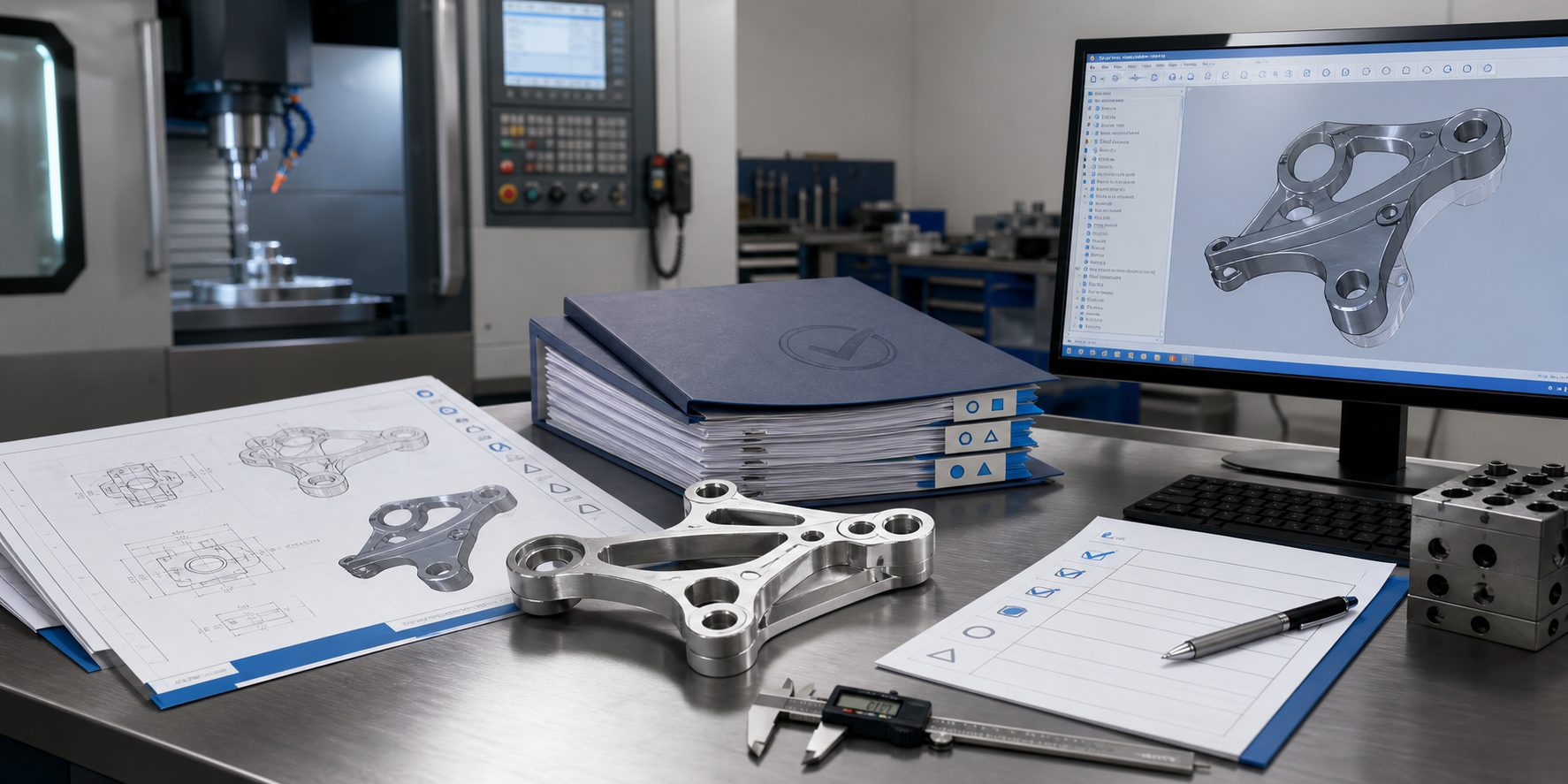
The fastest way to get a useful answer is to send:
- The 3D model
- The 2D drawing
- Material
- Quantity
- Tolerance
- Surface finish
- The purpose of the undercut
Our CNC machining team can review the geometry and compare standard tooling, custom tooling, and multi-axis options for your part.
Planning a CNC-milled part with an undercut? Send your drawing or 3D model for a practical manufacturing review and quotation.